Haunts fit for any vamp or wolf. Each book came with a list of great travel destinations to fulfill your curiosity.
For the Vamps:
Places I'd Visit: Transylvania of course, the area itself does seem quite interesting. Did you know there is such a thing as Dracula tours? I'd probably favor New Orleans over anything else, the city is just filled with so much history and it is probably a place that I could more realistically venture to. Of course one of my dream places to go to is Crete and not only is the little island known for being the origin story of the minotaur or the possible real life Atlantis, but it is also home to vampires who reign during the day.
For the Wolves:
Places I'd Visit:My love for fairytales leads me to the Black Forest. I just couldn't pass up being in the same place that many of my favorite tales take place. I would also take an interest into going to cultural significant places such as Rome or Kyoto.
What are some of your favorite vampire/werewolf destinations? Leave a comment.
We write for the attention of all Hollywood producers, writers, and
most certainly directors of horror cinema over the last couple of
decades. Quite a lot of you have been responsible for a serious crime,
too-often committed against us, the paying horror audience: incompetent
and complacent film making. The growing laziness in the genre has become
more and more obvious, certainly since the turn of the millennium. We
wish to address this by taking a look at some of the major errors you
tend to make; horror from the rest of the world does not seem to make
these mistakes, and so there is no reason you should:
Anyone can make us jump
Okay
so we all love a good jump here and there; trust us, we really do! It
is a great moment when you are sat there... tense, curious, nervous...
and then BANG, the 'thing' happens and the entire screen
(hopefully completely rammed, because this movie is supposed to
incredibly epic) jumps and screams in unison. Indeed, it brings about an
immediate sense of togetherness - camaraderie, if you like, and the
relief laughter and chatter is a very pleasing sound that nobody will
ever moan about.
It should be remembered, however, that this can very quickly be overdone (I’m looking at you, The Woman In Black),
and in fact even with the jump-scares you do use, you need to be
careful that they do not become cheap or unrealistic; the last thing we
want is to be immersed in the atmosphere of a scene and for the wrong
thing make us jump.
You think this means we feel more scared, but sometimes the opposite
is actually true; a badly-judged jump-scare will certainly make us jump,
but will be followed closely by laughter, leaving us detached from both
the horror and the film.
Why does this happen? It all comes down to whether the jump works as
part of the story, and as part of a particular scene. Frank Darabont,
speaking about one particular jump-scare in his adaptation of Stephen
King’s The Mist', said that it was “the oldest trick in the book” that
got the author leaping from his seat when watching it for the first
time.
Brilliant...he thinks he made Stephen King jump; but with that quote
he does actually hit the nail on the head! We all know the jump-scare
can be used to good effect, because it is indeed “the oldest trick in
the book”: the frame is set and then something bursts into it
unexpectedly.
The thing is we can all make somebody jump, it is very
simple; jump out on them, or sneak up behind them when they are not
expecting it and say boo really loudly. That is great, and fun, but
ultimately not scary in the long-term. It should also be pointed out
that film makers with actors, make-up, lighting, set design, hopefully a
scary story to tell, and a long list of other tools to hand should not
be resorting to a simple little trick - one readily available to us at
home - before hoping that a barrage of the same trick will send us home
with a need to tell everybody how frightening the film is.
We won’t.
Hollywood, if that's all you have to offer then I can promise you we will be talking about it at home...just not in the light you may have hoped.
"Using a jump as a pay-off to a building of tension gets tired after a while - trust us"
Please understand this is not to suggest we do not like the occasional good jump. For instance, a film like Rec has
just the right amount of jumps peppered through, but the creation of
tension envelops the moments rather than providing a build up. The
result is that we find ourselves totally shaken by the superb jump, but
not off the hook, as the dread continues to build. Using a jump as a pay-off to a building of tension gets tired after a while - trust us.
Enjoy the silence
It is one of the most basic principles of cinema: the soundtrack aids
the emotional drive of a movie. It tells us when to feel certain
feelings, amongst other things. Sadness, longing, excitement, tension,
and yes, even fear! You have heard of the expression, “over-egging the
pudding” though, yes? Any film that is over-scored is annoying; but in
the realm of terror, it can very easily dispel the fear rather than
enhance it. There are some truly terrifying moments in cinema from
around the world that work because they understand that silence can be
deafening in the right circumstances.
Take A Tale Of Two Sisters for example - this contains one of the most chilling bedroom sequences in a horror film since Poltergeist;
and take note of the fact that the director does not insist on bashing
you over the head with a discordant orchestra sting because “that it
will amplify the scare", but in fact relies purely on the natural sounds
of the room. Likewise, in another scene, the atmosphere is deathly-cold
and incredibly tense, through nothing more than the excellent sound of
wind.
In silence, we are tense; we are waiting for something awful, and
that natural sound of what is around us, even if it's pure silence, can
be deafening and creepier than any piece of music you wish to add to the
scene.
Music enhances shocking moments nicely, such as the shower-stabbing in Psycho;
but if you go and watch the scene now and take note of the sound that
leads up to the moment, what do you notice? A shower running. That is
the only sound.
Silence can be your greatest weapon.
Don’t butcher the fear
When
you have all your footage, resist the urge to hack away and re-assemble
every last frame. In horror, possibly more so than any other genre,
what the camera shows us, what we see and when we see it, could never be more important.
Sometimes the way some of you chuck this stuff together can be
mind-boggling, headache-inducing; and, worst of all, not scary. The fear
can be found with the right cut at the right time, so keep away from
the editing studio...
Take a little look at The Birds. Do we really need to
mention that classic scene that is simply one woman sat on a bench while
we know the birds are gathering? We don’t need to see it; we can
already sense what's going to happen. That way, when the shot is finally
panned into view, the true horror of the situation - that is, a
climbing frame crammed with birds - confirms our fears and raises the
suspense to unbearable levels.
One of the greatest examples from overseas is most certainly Ju-On: The Grudge.
I can barely put into words the feeling of realising that creepy little
kid is peering through the banister; he’s been there for how long? Fear presents itself through the unknown and Ju-On: The Grudge makes full use of the fact.
Many of you have taken heed of this already, as shown in the recent Insidious, which, despite its silly final act, does very well in this field. Likewise with The Strangers, there is a moment in the kitchen which is very successful.
Not everyone gets it right though; Gore Verbinski’s take on The Ring features
a re-working of the most frightening sequence in the original, and
makes a complete hash of it by having no sense of pace.
Getting the cut right is a big part of the challenge.
"Get us to care about something, anything, and you will drive the fear deeper..."
Nothing scarier than the imagination
Served as an accompaniment to the previous point, this was a notion associated very heavily with The Silence of the Lambs,
a film which comes to a climax in a room where nothing can be seen. Our
heroine Clarice Starling is feeling her way around a dark room, knowing
the killer is with her, watching. This works as a nice analogy for a
principle of horror that Hitchcock, once again, understood all too well:
Often it is what you do not see that is frightening.
Remember, our minds are dark closets filled with the most messed up,
disturbing thoughts you could imagine, and we love to exaggerate, to go
overboard; usually we just need a little push. So you can show us all
the monsters, beasts, ghosts, blood and guts you like, and there will be
the time and place for that. But you are so frequently better off
giving us a just a taste of it, a hint of what it is we are to be scared about - and then leave us to fill in the blanks.
Remember, The Blair Witch Project? With no need to pander to anybody, they kept everything low-key and ridiculously simple. It could even be argued that Blair Witch is
not technically a great film - but with the marketing campaign giving
it a head-start, it became the most effective American horror of the
decade. Admittedly it hinges on whether you play along with the notion
of being lost in the woods; but at no point do we see the antagonist; at
no point do we even know what it/she is. Instead we hear the right
things at the right times, and we watch as a woman runs through the
woods, clearly having seen something that we cannot. And it is horrible!
H. P. Lovecraft has been a long-standing example of an author who
scares the pants off his readers, all of whom find it extremely
difficult to tell you why they are scared. We all wait on tender-hooks
for the possible Del Toro production of At The Mountains of Madness, which seems to be under strain; but we shall see.
Put simply, keep it simple Hollywood...let us do your work for you, because we are very good at it.
If we care, we will scare
Since the advent of torture-porn, it has been very easy for people
like Eli Roth (a reasonable film maker in his own way) and Rob Zombie (a
not so reasonable film maker), to get away with presenting the most
turgid, infantile filth, often in the form of the most ridiculous,
over-the-top, moronic splatter-fests, and pretend that they have done
something really subversive, clever and scary.
I
have news for people like this: There is no subversion, and there is
nothing clever about torture when there is no drive behind it other than
the question, “How hideous can people be?”.
We know this already. We see real life happen. As for being scary, both Eli Roth and Rob Zombie admire Audition by Takashi Miike and presumably believe that they are paying homage to a master of the genre, because hey, he did a torture scene too!
Indeed he did, and if you go take a look at that film, you will
notice it turns the genre on its head, and consequently the audience; it
is a movie that blindfolds us, spins us in fast circles, and tells us
to pin the tail on the donkey. It makes us care for the very real
characters, so that when the horror finally hits home, it hurts us - and we understand its significance.
Take a look at the Guillermo Del Toro produced The Orphanage or even his own movie Cronos. Both
are films that have sincere themes and exploit honest, human fears -
the one concerning child death and another the subject of ageing. What
does torture-porn talk about?
More often than not the best horror stems from within: our own fears
about life, death, and the tragedy that is sometimes being human. There
is only so much blood and guts being spilled for its own sake that we
can watch before we simply get bored and immune. Themes we care about
never tire. They are about us, they are ideas we must care about.
David Cronenberg is a director whose shocking horror remains a
triumph by virtue of the revolution he brought about: in 'body horror' -
horror of the flesh. Watch The Fly, his re-working of a
classic yet simple fable, and witness a master at work. Using the fly
metamorphosis as a metaphor for our fear of disease - the horror from
which we cannot escape - is a journey into deep-seated terror. To bring
that to a point where we are both mortified and heartbroken for a man
who has become useless in front of his loved one is truly a stroke of
genius.
With
horror often comes a tremendous sense of sadness, or tragedy,
emphasising the terror, driving the story home and haunting us for days
or weeks. These are the films we talk about; these are the films horror
geeks adore. Yes, we enjoy a bit of teen-hacking as much as the next
man, but even with films such as A Nightmare On Elm Street, The Last House On The Left or The Hills Have Eyes,
you are watching work from a film-maker trying to present ideas that
run deeper than the carving-up of flesh; ideas that are supposed to bury
themselves in your head and get you thinking. That is one pivotal
element of the way these films scare - empathy, sense memory - driving
fear deeper.
Stop cheating!
Even the most forgiving horror nerds are becoming frustrated with the
endless stream of remakes - often recreated almost shot-for-shot - just
because you want to make an easy buck. We are wise to the game, and as
much as you might hoodwink a lot of the naive, you are not getting one
over on horror fans; we grow tired of your minimalist imagination.
Unless there is a writer’s strike, there is no reason for it - it is
just cheating and, if we are being honest, the remake rarely has the
qualities that made the original so great, notwithstanding how well-made
it is.
And renaming it does not make the crime any more forgiveable, so please stop doing it.
Conclusion – Trust us, we have a brain
There will always be a lowest common denominator audience out there -
those who cannot keep up with cinema that pushes them to engage their
brains beyond that point required to understand the twist of a Saw movie.
But that's not a reason to water everything down, resort to cheap
tricks and simple, one-dimensional set-ups that do not stay with us for
more than five minutes after walking out of the cinema.
Horror is at its best and most terrifying when it has a brain. The
frustrating thing is that the history of cinema from the West shows that
there have been those artists who have understood the above-mentioned. So what has happened?
You can take this as an appeal to the darkest part of your hearts,
and the smartest, most twisted corners of your collective imagination
that quietly crave to be more daring: Stop playing it down for the
simple-minded audience all the time and start proving that which we
know, you know, to be true - horror can be so much more than “slash and
hack”.
"We want the real monsters, the intelligence, the tragedy, the sadness and the metaphors"
We need the horror that avoids the tired clichés, the torture porn,
the over-cutting for the short attention spans, and the predictable
jump-scares for those who think that these alone create fear. Alfred
Hitchcock did not need such tricks when making The Birds and Psycho; even with Vertigo, which is not a horror movie, Hitchcock was able to create a chilling and genuinely haunting thriller.
William Friedkin, with 1973's The Exorcist, did not need to
resort to such banal methods to create what is still regarded, despite
its relative crudity when compared with modern films, as one of the
greatest horror movies of all time.
David Cronenberg, the director who showed you how to use visual
metaphor to explore the most horrendous themes, is a man whose horror
work was heralded as brilliant simply for being high-brow, for being
about concepts of the fear within, the horror of identity, the very real
terror that comes simply with being human. He made films about ideas for the most deeply-rooted, ugly parts of us to relate to.
We want that sort of horror - it is cleansing, therapeutic and
healthy. We want the real monsters, the intelligence, the tragedy, the
sadness and the metaphors.
In short, we need the horror that runs deeper than a pint of blood
smeared across the screen, in the vain hope it will be enough to keep us
awake at night.
Yours faithfully,
The Audience
A letter that could have been written by any horror fan. Thank you Daniel Elford for wording it all so perfectly. You can see the original here.
Now for the rest of us who are nostalgic for real horror; check out Channel 4's 100 Scariest moments. It's all based off of what viewers chose. It's a bit different from what many American channels would have for 100 scariest moments because Channel 4 is a British channel. There are many predictable moments such as Jaws, Halloween, and what not, but there are some different moments on there as well.
Some highlights
#100 Oncoming Train (Ha! I just find this one so fascinating. Great to know they looked back into history for what scared people
# 94 Cat People (I'm always happy to see this movie getting credit for what it did for horror)
# 89 Atomic Fallout Public Announcement (I would have honestly put this much higher. There is nothing scarier than having the presence of horror being possibly integrated in your everyday life.)
# 80 Snow White (Oh, Disney getting us hooked on scares at such a young age.)
# 72 Alice Cooper... Just Alice Cooper (Haha! Of course.)
#71 Thriller- Micheal Jackson (Still one of the greatest music videos of all time.)
# 54 Dr. Who Theme (Best Television theme of all time)
# 39 Dr. Who and the Daleks (Nothing scarier than a robot with a plunger)
# 25 Buffy-Hush (A very scary episode from my favorite show.)
# 21 Twin Peaks (A very strange and odd show. There will never be anything quite like it.)
Oh my goodness it's finally here. The trailer for the film that I've waited a couple of years to see. Lets take a look.
...........Yeah um that's not very Dark Shadowy at all. I know the show was known for its cheesiness, but come on some of the things shown here are a tad ridiculous. Even if the show was a little hooky it still had some class to it and did have a bit of a horror aspect to it even if it wasn't exactly scary. Well maybe its just a bad trailer perhaps the poster will be better.
Well someone discovered the paint overlay option on adobe illustrator.
Next we have the new trailer for Burton's new movie Frankenweenie
This film is a remake of one of Burton's earlier short films. Back in the day the Disney Channel would air the short around Halloween time. It looks really great. Not only does the stop motion look amazing, but it looks like they've improved on the original story a little bit. I can understand why Burton would want to remake this. The original was low budget in comparison and he was probably never able to make the film to his vision.
Now for a historical piece.
The film is produced by Burton and is based off a book written by Seth Grahame-Smith, the writer of Pride and Prejudice and Zombies.
Looks like a busy year for Burton with Zombies, undead dogs, and badass monster fighting presidents. Now we have to wait to see which films will excel and which ones will bomb.
Yep, that's right a whole robe and a scarf were completely woven from spider thread. Spiders from Madagascar to be exact. For the spooky darlings that are thinking of now having a closet full of spider woven garments, I have bad news for you in order to produce such a garment is quite a process and terribly expensive. The cloak shown above was made in four years with over a million spiders and done with a weaving technique that hasn't been used since the 1800s.
The Golden Orb spider is able to produce strands of golden colored threads and it takes 96 strands of thread to make a single fiber. The history of spider weaving is actually pretty remarkable and started back in 1710 with François Xavier Bon de Saint Hilaire. He discovered that one can actually spin spider threading to produce textiles. He was able to do this by boiling the cocoons and using the comb to separate the fibers. In the early 1800s Raimondo Maria de Termeyer discovered that one could extract the threads from the source itself and thus producing a higher-quality silk. A machine was made up around 1807 to perform such a task. In the late 1800s there was a short period of spider weaving popularity, but it sadly died out as soon as it came to be. Bedroom drapes were known to be produced during this time period, but no surviving specimens are known to exist.
The cloak and scarf that were produced are truly remarkable one of the amazing properties about the Golden Orb spider's thread is that the fibers are so light and delicate that one hardly notices them touching you. When one has their eyes closed and a portion of the cape is put into ones hand, that person is unable to tell that they are actually holding anything. Many are calling the garment a real life invisibility cloak due to how light it is.
This is a closeup of the intricate weaving woven into the cloak. Doesn't it remind you of the tale of Arachne?
The cloak itself is currently on display at the Victoria and Albert museum in London (A.K.A the Greatest museum of all time.)
When I was little I heard the tale of The Velvet Ribbon in a children's horror book called "In a Dark, Dark Room and Other Scary Stories" The tale was simple and short, but for some reason the tale was just so darn memorable. The story itself is eerie and depending on the version you hear/read it might give you a nightmare or two. I find it interesting that in each version of the story, the husbands interest in the velvet ribbon becomes an obsession. We never find out why the wife is headless and much to the husbands dismay his wife's past is ambiguous in nature. The ribbon could symbolize the woman's past and the man's inability or ability to come to terms with the fact that no matter her past will remain a mystery till she deems him worthy enough to reveal it to him.
Version 1:
She was beautiful in a strange, mysterious way. Her hair and her deep bottomless eyes were as black as the velvet ribbon around her neck. He planned to marry her before the next full moon rose in the autumn sky.
On their wedding, he watched her walked towards him up the long aisle. She was dressed in a white gown, a white veil, and carried a bouquet of white flowers. Even her face was ivory white. But below it, around the ivory neck, was the black velvet ribbon. He remembered staring at that ribbon as the strains of the wedding march brought his bride nearer to him. He remembered the curious and shocked looks on the faces of the wedding guests. But then his eyes met hers, and he was drowning in their bottomless darkness.
He didn't think of the velvet ribbon during the rest of his wedding day. It was a joyous time, and if people thought his wife was a bit strange, they kept that to themselves. That night, when they were alone, he saw that the ribbon was still there, still circling her lovely neck.
"Don't you ever take that ribbon from around your neck?" he asked, hoping his question was a needless one.
You'll be sorry if I do," his wife answered, "so I won't."
Her answer disturbed him, but he did not question her further. There was plenty of time for her to change her ways.
Their life together fell into a pleasant pattern. They were happy, as most newly married couples are. He found her to be a perfect wife... well, nearly perfect. Although she had a great number of dresses and wore a different one every day, she never changed the black velvet ribbon. This ribbon began to be the test of their marriage. When he looked at her, his eyes would inevitably fall to her neck. When he kissed her, he could feel the ribbon tightening around his own throat.
"Won't you please take that ribbon from around your neck?" he asked her time and time again.
"You'll be sorry if I do, so I won't." This was always her answer. At first it teased him. Then it began to grate on his nerves. Now it was beginning to infuriate him.
"You'll be sorry if I do."
"You'll be sorry if I do."
One day he tried to pull the ribbon off after she had repeated her answer, like a mechanical doll. It wouldn't come loose from her neck. He realized then, for the first time, that the ribbon had no beginning and no end. It circled her neck like a band of steel. He had drawn back from her in disgust that day. Things weren't the same with them after that.
At the breakfast table, the black ribbon seemed to mock him as he drank his suddenly bitter coffee. In the afternoon, outisde, the ribbon made a funeral out of the sunlight. But it was at night when it bothered him the most. He knew he could live with it no longer.
"Either take that ribbon off, or I will," he said one night to his wife of only four weeks.
"You'll be sorry if I do, so I won't." She smiled at him, and then fell off to sleep.
But he did not sleep. He lay there, staring at the hated ribbon. He had meant what he said. If she would not take off the ribbon, he would.
As she lay sleeping and unsuspecting, he crept out of bed and over to her sewing box. He had seen a small, sharp scissors she kept there. It was thin enough, he knew, to slip between the velvet ribbon and her soft neck. Gripping the scissors in his trembling hands, he walked softly back to the bed. He came up to where she lay and stood over her. Her head was thrown back on the pillow, and her throat with the black velvet ribbon around it rose ever so slightly with her breathing.
He bent down, and with one swift movement, he forced the thin blade of the scissors under the ribbon. Then with a quick, triumphant snip, he severed the ribbon that had come between them.
The black velvet ribbon fell away from his wife's neck....her head rolled off the bed and landed on the floor with a thump. She was muttering, "You'll be sorry, you'll be sorry......."
Once there was a man who fell in love with a beautiful girl. And before
the next full moon rose in the sky, they were wed.
To please her husband, the young wife wore a different gown each night.
Sometimes she was dressed in yellow; other nights she wore red or blue
or white. And she always wore a black velvet ribbon around her slender
neck.
Day and night she wore that ribbon, and it was not long before her
husband's curiosity got the better of him.
"Why do you always wear that ribbon?" he asked.
She smiled a strange smile and said not a word.
At last her husband got angry. And one night he shouted at his bride.
"Take that ribbon off! I'm tired of looking at it."
You will be sorry if I do," she replied, "so I won't." Every morning at
breakfast, the husband ordered his wife to remove the black velvet
ribbon from around her neck. Every night at dinner he told her the same
thing.
But every morning at breakfast and every night at dinner, all his wife.
would say was, "You'll be sorry if I do. So I won't."
A week had passed. The husband no longer looked into his wife's eyes. He
could only stare at that black velvet ribbon around her neck.
One night as his wife lay sleeping, he tiptoed to her sewing basket. He
took out a pair of scissors.
Quickly and quietly, careful not to awaken her, he bent over his wife's
bed
and
SNIP! went the scissors, and the velvet ribbon fell to the floor
and
SNAP! off came her head. It rolled over the floor in the moonlight,
wailing tearfully:
"I...told...you...you'd...be...s-o-r-r-y!"
Version 3:
Yellow Ribbon
retold by S.E. Schlosser
Jane wore a yellow ribbon around her neck everyday. And I mean everyday, rain or shine, whether it matched her outfit or not. It annoyed her best friend Johnny after awhile. He was her next door neighbor and had known Jane since she was three. When he was young, he had barely noticed the yellow ribbon, but now they were in high school together, it bothered him.
“Why do you wear that yellow ribbon around your neck, Jane?” he’d ask her every day. But she wouldn’t tell him.
Still, in spite of this aggravation, Johnny thought she was cute. He asked her to the soda shoppe for an ice cream sundae. Then he asked her to watch him play in the football game. Then he started seeing her home. And come the spring, he asked her to the dance. Jane always said yes when he asked her out. And she always wore a yellow dress to match the ribbon around her neck.
It finally occurred to Johnny that he and Jane were going steady, and he still didn’t know why she wore the yellow ribbon around her neck. So he asked her about it yet again, and yet again she did not tell him. “Maybe someday I’ll tell you about it,” she’d reply. Someday! That answer annoyed Johnny, but he shrugged it off, because Jane was so cute and fun to be with.
Well, time flew past, as it has a habit of doing, and one day Johnny proposed to Jane and was accepted. They planned a big wedding, and Jane hinted that she might tell him about the yellow ribbon around her neck on their wedding day. But somehow, what with the preparations and his beautiful bride, and the lovely reception, Johnny never got around to asking Jane about it. And when he did remember, she got a bit teary-eyed, and said: “We are so happy together, what difference does it make?” And Johnny decided she was right.
Johnny and Jane raised a family of four, with the usual ups and downs, laughter and tears. When their golden anniversary rolled around, Johnny once again asked Jane about the yellow ribbon around her neck. It was the first time he’d brought it up since the week after their wedding. Whenever their children asked him about it, he’d always hushed them, and somehow none of the kids had dared ask their mother. Jane gave Johnny as sad look and said: “Johnny, you’ve waited this long. You can wait awhile longer.”
And Johnny agreed. It was not until Jane was on her death bed a year later that Johnny, seeing his last chance slip away, asked Jane one final time about the yellow ribbon she wore around her neck. She shook her head a bit at his persistence, and then said with a sad smile: “Okay Johnny, you can go ahead and untie it.”
With shaking hands, Johnny fumbled for the knot and untied the yellow ribbon around his wife’s neck.
And Jane’s head fell off.
Origins of the Tale
The origin of the tale is unknown, but many believe that the tale roots back to the French Revolution. The events and occurrences of the French Revolution are in fact nightmarish in their own right. After the "Reign of Terror" it became fashionable for the youth who had lost a personal family member to revolution to throw macabre soirees known as 'Les bals des victimes', or 'The victims’ balls'. It was at these parties where a series of strange and rebellious fashions began to make a scene. Women and men both cut their hair in the style of cheveux à la titus, a style used to commemorate the same cut that was given to the victims of the guillotine. This short hairstyle for men became terribly fashionable throughout Europe and really started the trend for men to have short hair.(The French Reveloution is responsible for quite a few of our modern day fashions, like pants.) The women had their own special fashion, red ribbons were worn across the upper back of dresses and most importantly women began to wear red ribbons around their neck to symbolize where the blade of the guillotine had cut the victims of the "Reign of Tower".
Perhaps, it was during this time period that the tale of "The Velvet Ribbon" was formed, but untill I can find solid information I can't really say for sure. All, that I know for a fact is that the tale will live on and many more versions will be seen in the future.
Horror has a known history of being shunned at the Oscars for whatever reason. Probably because the genre is typecasted as being all about blood, guts, and over sexualized screaming teenagers. Even when an insightful horror film comes along and decides to contend with the big boys at the Oscars it still gets overlooked even though most horror films are far more intelligent then people give them credit for.
I suppose it would be interesting to take a look back at the over all history that the Horror genre has had with the Oscars. Has it really been as left out as many say?
In 1932 horror makes an appearance when the classic"Dr.Jekyll and Mr.Hyde" picked up nominations for Best Cinematography, and Best Writing, Adaption. Surprisingly Fredric March wins Best Actor for his portrayal of the mad doctor in the film.
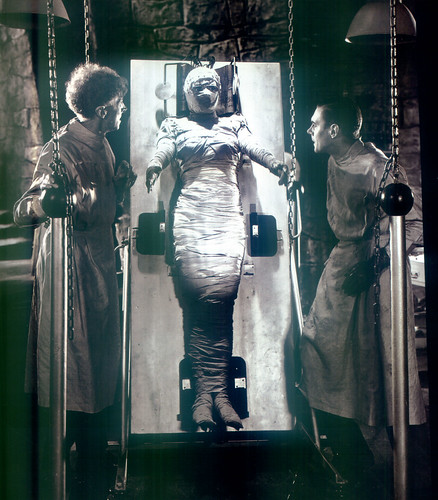
In 1936 Universal's crown jewel of horror classics "The Bride of Frankenstein" is nominated for Best, sound recording. (Not much, but hey at least it got a nomination for something."
In 1961 Alfred Hitchcock influential classic "Psycho" was nominated for Best Actress, Best Black/White Art Direction, Best Black/White Cinematography, and Best Director. Note: Alfred Hitchcock was nominated for best director only four times by the Oscars and he never won. The Oscars was nice enough to give him a memorial award though.
In 1963 "What Ever Happened to Baby Jane" took center stage by picking up nominations for Best Sound, Best Cinematography Black/White, Best Supporting Actor, and Best Supporting Actress for Bette Davis. It only won one award for Best Costume. Random Fact: Did you know that the Oscar supposedly got it's name from Bette Davis naming the award after her ex-husband , Harmon Oscar Nelson, Jr.
In 1969 the Roman Polanski was nominated for Best Adapted screenplay for "Rosemary's Baby". Ruth Gordon took home Best Supporting Actress for her role in the film.
In 1974 "The Exorcist" was nominated for Best Picture, Director, Actress, Cinematography, Editing, Supporting Actor, Supporting Actress, and Art Direction. It won Best Adapted Screenplay and Best Sound.
In 1975 the horror inspired comedy "Young Frankenstein" is nominated for Best Screenplay and Best Sound.
In 1976 Jaws changed things up a bit by winning Best Editing, Best Film Score, (Rightfully so) , Best Sound, but unfortunately didn't win Best Picture when it lost to One Flew Over the Cuckoo's Nest. (At least it was nominated)
In 1977 Sissy Spacek was nominated for her role as Carrie in the Stephen King adapted film "Carrie". Piper Laurie was nominated for Best Supporting Role Actress.
In 1980 James Cameron's classic "Alien" won for Best Visual Effects. It was only nominated in one other category, which was Best Art Direction. The darn thing should of had nominations such as Best Actress, Best Director, and Best Film. Darn it, Oscar's if Disney found Alien important enough to feature on its great movie ride you could have least given it proper recognition at the Oscars. -sigh- Another example of some good old horror snubbing. That same year The Amittyville Horror was nominated for best musical score.
In 1982 An American Werewolf in London won for Best Makeup.
In 1983 Poltergeist was nominated for Best Visual Effect, Best Sound Editing, and Best Score.
In 1987 "Aliens" won Best Sound Effects and Best Visual Effects. It was nominated for Best Sound,Best Original Score, Best Film Editing, Best Art Direction and Sigourney Weaver was nominated for Best Actress. (She should have won though. -_-) That same year " The Fly" wins for Best Makeup.
In 1989 the Tim Burton horrorish comedy Bettlejuice won for Best Visual Effects.
In1991 Horror makes a splash in the scene by having Kathy Bates taking home an award for Best Actress in the film "Misery"
In 1992 an amazing thing happened "The Silence of the Lambs" swept the Oscars winning Best Picture, Best Director, Best Actor, Best Actress, and Best Screenplay.It was also nominated for Best Sound and Best Editing.(Yeah, I know people bitch about it being more of a thriller than a horror, but many thriller films branch out from horror and "The Silence of the Lambs is one of them.) The Adams family was nominated for Best Costume Design that year. (The first film I ever saw by the way.)
In 1993 Francis Ford Coppola's "Dracula" won Best Costume, Sound Effects Editing, and Makeup. It was also nominated for Best Art Direction. The horror comedy "Death Becomes Her" wins Visual Effects. Oddly Alien 3 was nominated in the same category.
In 1995 Neil Jordan's "Interview with the Vampire" was nominated for Best Art Direction and Best Musical Score. Tim Burton's horror related film "Ed Wood" won Best Supporting Actor and Makeup, Kenneth Branagh's 'Frankenstein' was also nominated in that same category.
In 1996 David Fincher's "Se7en" was oddly only nominated for one Oscar Nomination, which was Best Film Editing. I honestly wonder about the Oscars sometimes. I mean if the Oscars loved 'The Silence of the Lambs" they should also love "Se7en".
In 2000 the now highly controversial M. Night Shymalan's "The Sixth Sense" earned six nominations including Best Picture, Best Actress, Best Supporting Actor, Best Original Screenplay, and Best Editing. Tim Burton's "Sleepy Hallow" was nominated for Cinematography, Costumes, and won an award for Art Direction.
In 2001 Three horror films were nominated for Best Makeup these were "Shadow of the Vampire", "Hallow Man" and "The Cell".
In 2007 Guillermo Del Toro's horror fantasy "Pan's Labryinth" was nominated for Best Original Screenplay, Best Score, and Best Foreign Film. Luckily the Oscars decided that the film did in fact deserve a few awards so the film won for Best Cinematography,Art Direction, and Makeup. (We are expecting great things from you Mr. Toro. Hopefully you can bring the Academy to truly appreciate the horror genre.)
In 2008 Tim Burton's delightful musical adaption of "Sweeney Todd" won for Best Actor, Best Art Direction, and Best Costume Direction. (Homicidal barbers get to be well dressed and groomed.)
In 2010 the beautifully filmed "Black Swan" was nominated for five Best Picture, Best Director, Best Achievement in Editing, and Best Cinematography. Natalie Portman was able to take home the Best Actress award for her role in the film. Oh yeah "The Wolfman" remake was able to earn Best Makeup category.
Yeah, I suppose the Oscar snub of horror isn't too bad when you look at it. I mean at least it gets mentioned here and there, but would it kill the Academy to actually put more horror films in the top contending categories. After all chances are that horror film that is overlooked is far more likely to be remembered and beloved for years to come.
82nd Academy Award tried to appease us horror fans by doing a tribute to horror. Let us see how Successful they were.
-_- Besides the fact Twilight was involved at all I'd say the tribute was descent. There were quite a few films I wouldn't have expected in the tribute, but more variety in the films would have been nice. Eh maybe this means The Oscars will take more interest in horror; after all Black Swan was able to pick up quite a few nominations. Only time will tell.
I had the opportunity to rent Universal Studios Monsters:A Legacy of Horror from the library. I thought it would be a great resource of inspiration for my classic horror theme Halloween/birthday party. (Yes, I plan my Halloween party a year ahead of time.)
The book covers the early years of Hollywood and how Universal Studios got started and what led them to do the Horror films we know and love to this very day. Universal's main horror films get their own special section and even some lesser known horror films get a chance to be in the limelight. The book provides many facts and trivia that the everyday horror fan might not know, but they should. For example the actress Gloria Stuart the actress who played the old Rose in Titanic got her start in Universal Horror film?
There are many gorgeous pictures featured within the book, which really is the best part of the book. You'll also get a chance to learn a little more about your favorite horror actors such as Bela Lugosi and Barlos Karloff. My only complaint with the book is the synopsis that is given for each movie, but I suppose if you have yet to see some of the films it can help you to become interested in the films and go out and seek them.
This book would be perfect for the coffee table or it can make a great gift for an upcoming horror fan.